
Publications

Select the year of publication...
| 2016-2018 | 2019-2021 | 2022-2023 | 2024 |
| 2004-2006 | 2007-2009 | 2010-2012 | 2013-2015 |
| before 1990 | 1991-1995 | 1996-2000 | 2001-2003 |
...or go to the
Recent Publications
Da Huang, Thorsten Hugel, and Günter Reiter. Macromolecules, published online
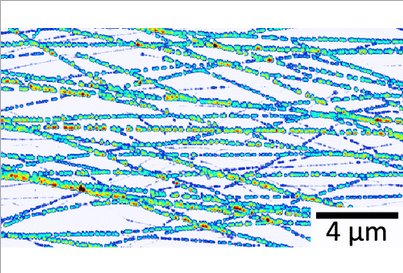 We have investigated the formation of millimeter-long filaments induced by spin-coating ca. 130 °C dilute para-xylene solutions of rapidly crystallizable polyethylene chains with a contour length in the micrometer range onto ca. 80 °C mica substrates. These filaments were radially oriented and accumulated on the periphery of the substrate. Our observations can be explained by the stretching of polymers through the flow field induced by spinning the solution on a solid substrate. The corresponding loss in conformational entropy emphasized attractive interactions between polymers, which resulted in the formation of bundles and their assembly into long filaments. Caused by a Plateau–Rayleigh-type instability of a liquid coating on a solid filament and due to crystallization, these filaments were decorated with various small-scale structures. (more...)
Mina Alizadehaghdam, Farhang Abbasi, Günter Reiter. J. Phys. Chem. C 128 (2024) 4757–4765
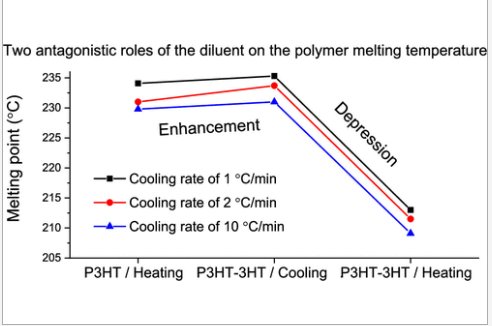 Crystallization of poly(3-hexylthiophene) (P3HT) was studied in mixtures of different concentrations of 3-hexylthiophene (3HT) as a diluent. Two coexisting crystal populations, socalled “thin” and “thick” crystals, with melting temperatures differing by more than 10 °C were observed in these mixtures. Intriguingly, the “thick” crystals represented transient unstable structures, with a mass fraction that was the highest ФH for rapidly crystallized P3HT in presence of significant amount of diluent. Reflecting its dependence on growth kinetics, ФH decreased with increasing crystallization temperature, extended crystallization time or lower cooling rate. The presence of a diluent led to a “depression” of the melting temperature, described by Raoult’s law and the Flory equation, which was similar for P3HT samples crystallized in various ways. (more...)
Claas-Hendrik Stamp, Binyam Solomon, Friederike Lang, Efstathios Mitropoulos and Thomas Pfohl.
Lab Chip 23 (2023) 3662-3670
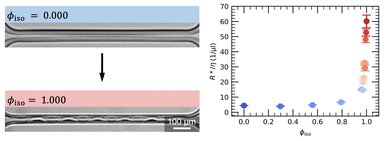 Controlling fluid flow in microfluidic devices and adapting it to varying conditions by selectively regulating hydrodynamic properties is of critical importance, as the field of microfluidics faces increasingly complex challenges in its wide range of applications. One way to manipulate flows in microfluidic devices is to introduce elastic elements that can be actively or passively deformed. In this work, we developed a membrane-based microfluidic device that allows us to study the deformation of swollen thin membranes as a function of the volume fractions in binary mixtures – here isopropanol and water. (more...)
List of Publications
- Steps in the transition of an entangled polymer melt to the partially crystalline state
- B. Heck, T. Hugel, M. Iijima, E. Sadiku, G. Strobl. New Journal of Physics 1, 17 (1999).
- Building lamellae from blocks: The pathway followed in the formation of crystallites of syndiotactic polypropylene
- T. Hugel, G. Strobl, R. Thomann. Acta Polymerica, 50, 214 (1999)
- Adhesion Failure and Dewetting of Thin Liquid Films
- A. Sharma, R. Khanna and G. Reiter. Festschrift on Adhesion Science and Technology, p. 199-237, W.J. van Ooij and H.R. Anderson, eds., VSP Publishers, Utrecht (1998)
- Détermination de forces intermoléculaires par microscopie optique: effet de connecteurs polymères
- A.Casoli, G.Reiter, M.Brendlé, J. Schultz. Ouvrage des actes “Imagerie des Polymères” (Colloque international francophone, Nancy, Février 1998, (Apollor)
- Self-assembly of Crystallisable Diblock Copolymers
- G. Reiter, P. Hoerner, G. Hurtrez, G. Riess, J.-U. Sommer, J.-F. Joanny. J. Surf. Sci. Tech. 14 , 93-103 (1998)
- Role of Intermolecular Interactions in Pattern Formation in Unstable Thin Films
- A. Sharma, G. Reiter. Metals Materials and Processes 10, 287-302 (1998)
- The artistic side of intermolecular forces
- G. Reiter. Science 282, 888-889 (1998)
- Structure and dynamics of structure formation in model triarm star block copolymers of polystyrene, poly(ethylene oxide), and poly(epsilon-caprolactone)
- G. Floudas, G. Reiter, O. Lambert, P. Dumas. Macromolecules 31, 7279-7290 (1998)
- Crystallisation of Adsorbed Polymer Monolayers
- G. Reiter, J.-U. Sommer. Phys. Rev. Lett. 80, 3771 (1998)
- Deformation of a Glassy Polymer Film by Long-Range Intermolecular Forces
- M.O. David, G. Reiter, T. Sitthai, J. Schultz. Langmuir 14, 5667-5672 (1998)
- Capillary waves on a poly(vinylacetate) surface studied by off-specular diffuse X-ray scattering
- S. Bauer, G.R. Strobl. Polymer Bulletin 40, 291-296 (1998)
- Superheating effects during the melting of crystallites of syndiotactic polypropylene analysed by temperature-modulated differential scanning calorimetry
- J.E.K. Schawe, G.R. Strobl. Polymer 39, 3745-3751 (1998)
- The role of co-units in polymer crystallization and melting: New insights from studies on syndiotactic poly(propene-co-octene)
- G. Hauser, J. Schmidtke, G. Strobl. Macromolecules 31, 6250-6258 (1998)
- Synthesis and microphase separation of diblock copolymers of styrene and p-chlorostyrene prepared by using N-oxyl capped macroinitiators
- S. Butz, J. Hillermann, G. Schmidt-Naake, J. Kressler, R. Thomann, B. Heck, B. Stühn. Acta Polymerica 49, 693-699 (1998)
- La réflectivité des polymères
- G. Reiter. Chapitre VIII dans les actes de l'ecole française de réflectivité, à Marseille 1997, Eds. A. Gibaud, J. Daillant
- Surfactants: Eigenschaften und Einsatz in der Beschichtungstechnik
- G. Reiter. Kapitel 5: in Grundlagen und Verfahren der Beschichtungstechnik, Kurzlehrgang, Erlangen 1997
- Connectors in Adhesion and Contact Angle Hysteresis
- G. Reiter, A. Casoli, A. Sharma, P. Auroy. Dans les actes de JADH'97: 9émes Journées d'Etudes sur l'Adhesion, Sept. 1997 in St. Lary/F, Edition SFV, Paris 1997, p. 68-73
- Large-scale heterogeneities in entangled polymer solutions. Light-scattering study on polystyrene in toluene
- M. Heckmeier, M. Mix, G. Strobl. Macromolecules 30, 4454-4458 (1997)
- A four-state scheme for treating polymer crystallization and melting suggested by calorimetric and small angle X-ray scattering experiments on syndiotactic polypropylene
- J. Schmidtke, G. Strobl, T. ThurnAlbrecht. Macromolecules 30, 5804-5821 (1997)
- The Effect of Dissolved Side-Group Polymers on Pattern Dynamics in Nematic Liquid Crystals in a Rotating Magnetic Field
- E.E. Pashkovsky, W. Stille, G. Strobl and D. Talebi. J. Phys. II France 7 (1997) 707-727